Cipriani tops off Miami’s tallest tower south of Manhattan with $53M penthouses and a black book to match

Mary K. Jacob

Updated

4 min read

Add Yahoo as a preferred source to see more of our stories on Google.

Add Yahoo on Google

1

Cipriani Residences Miami is unveiling a pair of crown penthouses that'll set new buyers back $53 million combined.

Cipriani Residences Miami is unveiling a pair of crown penthouses that'll set new buyers back $53 million combined.

Key takeawaysPowered by Yahoo Scout. Yahoo is using AI to generate key points from this article. This means the info may not always match what’s in the article. Reporting mistakes helps us improve the experience.

  • Cipriani Residences Miami is unveiling a pair of crown penthouses priced at a combined $53 million, with one unit listed at $33 million and the other at $19.8 million.

See more

Cipriani Residences Miami is putting the finishing touch on its Brickell skyscraper with a pair of penthouses so lavish they come with their own zip code in the sky, The Post has learned.

The Italian hospitality empire unveiled The 1931 Collection this week, a two-unit offering perched atop the 950-foot tower that now stands as the tallest residential building south of Manhattan.

Together, the penthouses carry a combined price tag of $53 million, with the larger unit listed at $33 million and its companion at $19.8 million.

Cipriani Residences Miami is unveiling a pair of crown penthouses that'll set new buyers back $53 million combined. Hayes Davidson

Cipriani Residences Miami is unveiling a pair of crown penthouses that'll set new buyers back $53 million combined. Hayes Davidson

The penthouses are the final offering atop the 950-foot tower, now the tallest residential building south of Manhattan. The Boundary

The penthouses are the final offering atop the 950-foot tower, now the tallest residential building south of Manhattan. The Boundary

Named for the year Giuseppe Cipriani first opened the doors of Harry's Bar in Venice, the two residences sit on the building's uppermost floors and are meant to channel nearly a century of the family's hospitality instincts into full time living spaces rather than hotel suites.

Advertisement

The pricier of the pair, dubbed The San Marco, unfolds across three levels and 9,677 square feet of combined indoor and outdoor space. A 24-foot Great Room anchors the home, while a chef's kitchen finished in lacquered wood and Calacatta marble, an integrated wet bar and a dedicated wine display round out the entertaining areas.

The real showstopper sits upstairs, where a private rooftop delivers an infinity pool, summer kitchen, cold plunge, hot tub, massage pavilion and even a putting green with sweeping views of Biscayne Bay.

The $33M "San Marco" is a three-level, 9,677-square-foot sky estate with a 24-foot Great Room, private rooftop with its own infinity pool, cold plunge, hot tub, meditative massage pavilion and putting green. The Boundary

The $33M "San Marco" is a three-level, 9,677-square-foot sky estate with a 24-foot Great Room, private rooftop with its own infinity pool, cold plunge, hot tub, meditative massage pavilion and putting green. The Boundary

More

Its little sibling, the $19.8M "Torcello," is a more intimate 6,703 square feet but still packs its own pool, gym, screening room and a "Midnight Bar" built for after-dark entertaining. Hayes Davidson

Its little sibling, the $19.8M "Torcello," is a more intimate 6,703 square feet but still packs its own pool, gym, screening room and a "Midnight Bar" built for after-dark entertaining. Hayes Davidson

Named for the year Giuseppe Cipriani opened Harry's Bar in Venice, both units come with in-residence dining from the Cipriani culinary team and reservation access across the family's global address book — Harry's Bar Venice, Cipriani outposts in Monte Carlo, Dubai, Hong Kong. Getty

Named for the year Giuseppe Cipriani opened Harry's Bar in Venice, both units come with in-residence dining from the Cipriani culinary team and reservation access across the family's global address book — Harry's Bar Venice, Cipriani outposts in Monte Carlo, Dubai, Hong Kong. Getty

More

The building is already 85% sold to buyers from over 30 countries ahead of Summer 2027 occupancy. Hayes Davidson

The building is already 85% sold to buyers from over 30 countries ahead of Summer 2027 occupancy. Hayes Davidson

Its sibling unit, The Torcello, trades scale for intimacy at 6,703 square feet. Buyers still get their own infinity pool, gym, wellness room, cold plunge and hot tub outdoors, plus a private screening room and wine storage inside.

A standout feature is The Midnight Bar, a dedicated space built for cocktails and late night gatherings.

Both homes come stocked with the kind of perks money alone can't always buy elsewhere.

Residents get in-home dining prepared by the Cipriani culinary team, along with reservation privileges across the brand's international network, from the original Harry's Bar in Venice to Cipriani outposts in New York, Monte Carlo, Dubai, Hong Kong and Punta del Este.

Cipriani Residences Miami is a high-rise development located in the Brickell neighborhood of Miami, Florida. The Boundary

Cipriani Residences Miami is a high-rise development located in the Brickell neighborhood of Miami, Florida. The Boundary

The kitchen.  Hayes Davidson

The kitchen. Hayes Davidson

A view of Cipriani Residences Miami. Hayes Davidson

A view of Cipriani Residences Miami. Hayes Davidson

Lionel Messi has already purchased several units in the building ahead of its 2027 completion.  Getty Images for America Business Forum

Lionel Messi has already purchased several units in the building ahead of its 2027 completion. Getty Images for America Business Forum

"Cipriani has never simply been about a place, it is about what happens within it and what people carry with them long after they leave," Giuseppe Cipriani, who is developing the property with Mast Capital, told The Post. "Harry's Bar, Piazza San Marco and Locanda Cipriani have been part of our family's story for generations, but also of the lives of so many others."

Read more

South Florida Housing Market Gains Momentum as Sales Rise and Market Shifts Toward Sellers

by Chris Umpierre

Share0

Economic Insights

Economic Insights from the MIAMI REALTORS Chief Economist

By Gay Cororaton, MIAMI REALTORS + RWorld Chief Economist

Key Takeaways

  • July home sales rose for the 11th straight month, up 8.6% year-over-year, with year-to-date sales up 7.9%. Single-family sales rose in 72% of submarkets while condo/townhome sales rose in 63% of submarkets.
  • Year-to-date sales of million-dollar homes are up 22.9% from one year ago. Sales of $10 million or more rose to the highest six-month level at 346 sales, with 87% all-cash.
  • Active inventory continued to decline, down 18% year-over-year, providing support for stronger price gains. Median single-family sales prices rose year-over-year in all counties while condominium/townhome prices rose in Palm Beach County and St. Lucie County.
  • Download the July 2026 South Florida Housing Market Report HERE.

    South Florida’s housing market continued to show strength and momentum in July, with sales up for the 11th consecutive month in both single-family and condo/townhome segments. Million-dollar sales continued to increase at a double-digit pace. Single-family prices rose to their highest July levels as inventory continued to decline as sales outpaces new listings. This momentum is likely to continue, driven by an acceleration in out-of-state migration from high-tax states and net job migration in higher-paying professional/tech services, health care, and finance jobs. Expect South Florida’s housing market to continue to shift to a seller’s market and prices to continue to firm up.

    South Florida July sales rose for the 11th straight month, up 8.6% year-over-year, with year-to-date sales up 7.9%

    For the 11 straight month, South Florida’s closed sales of single-family and condominium/townhome sales in June increase from one year ago, up 8.6% year-over-year for the month of July. Year-to-date, sales rose 7.9% from the same period one year ago. Nationally, sales increased 2.8% year-over-year in July and 2.4% year-to-date.

    In the single-family market, July sales rose 8.9% and were up in all counties: Miami-Dade County ( 5.6%), Broward County (8.0%), Palm Beach County (12.7%), Martin County (23.4%), and St. Lucie County (2.4%).

    Year-to-date single-family sales were 8.9% higher from the same period one year ago, with sales up in all counties: Miami-Dade County (8.9%), Broward County (7.3%), Palm Beach County (11.6%), Martin County (18.2%), and St. Lucie County (3.0%).

    Year-to-date single-family sales increased in 72% of South Florida’s 180 submarket, including in the largest cities like Miami (+13%), Miami Gardens (+18%), Homestead (+6%), Coral Gables (+8%), Miami Beach (+4%), Fort Lauderdale (+13%), Hollywood (+12%), Pembroke Pines (+3%), Miramar (+17%), West Palm Beach (+24%), Palm Beach Gardens (+20%), Boca Raton (+18%), Jupiter (+17%), Palm City (+2%), and Port St. Lucie (+8%).

    In the condominiums/townhomes market, July sales rose 8.2% year-over-year and rose in nearly all counties: Miami-Dade County ( +11.4%), Broward County (-2.8%), Palm Beach County (+18.5%), Martin County (+6.9%), and St. Lucie County (+17.1%).

    Year-to-date condominium/townhome sales increased 6.8%, with sales up in all counties: Miami-Dade County (6.8%), Broward County (1.0%), Palm Beach County (11.3%), Martin County (25.7%), and St. Lucie County (9.2%).

    Year-to-date condominium/townhome sales increased in 63% of South Florida’s 136 condominium/townhome submarkets, including the largest cities of Miami (+13%), Miami Beach (+13%), Aventura (+18%), Sunny Isles Beach (+3%), Fort Lauderdale (+4%), Deerfield Beach (+8%), Hollywood (+4%), West Palm Beach (+17%), Delray Beach (+9%), Boynton Beach (+9%), Jupiter (+25%),Palm Beach Gardens (+11%), Stuart (+37%), and Port St. Lucie (+20%).

    Million-dollar sales growth outpaces overall sales, with year-to-date sales up 22.9% from one year ago

    Million-dollar sales continue to increase at a double-digit pace, with sales up for the 12th consecutive month in July, up 29.1% year-over-year. Year-to-date, sales are up 22.9%. Cash sales accounted for 60% of million-dollar sales.

    Year-to-date closed sales of $10 million and over homes rose to an all-time over this period to 346 sales with 98 more sales from one year ago. Miami-Dade County and Palm Beach County accounted for roughly 90% of $10 million or over transactions. Cash sales accounted for 87% of $10 million or more sales.

    Million-dollar sales continue to gain market share. In the single-family market, Palm Beach County had the highest share at 30%, followed by Miami-Dade County at 28%, Martin County at 21%, Broward County at 20%, and St. Lucie County at 2%. Nationally, million-dollar sales account for less than 10% of sales.

    Median single-family sales prices rose to all-time July highs, but condo prices continued to adjust downward in over half of submarkets

    The median single-family sales prices rose in July from one year ago in all counties led by Palm Beach County (+7.6%), followed by Broward County (+4.8%), Martin County (+4.3%), Miami-Dade County (+3.8%), and St. Lucie County (+2.6%).

    In the single-family market, prices were stable or rose in 56% of submarkets that include Miami (+3%), Miami Gardens (+7%), Coral Gables (+51%), Fort Lauderdale (+1%), Pembroke Pines (+10%), Miramar (+10%), West Palm Beach (+17%), Boca Raton (+24%), Palm Beach Gardens (+27%), Jupiter (+4%), Palm City (+11%), and Port St. Lucie (+2%).

    In the condominium/townhomes market, prices continue to adjust downward, with sales prices only rising in Palm Beach County for the 5th consecutive month (+4%) and starting to recover in St. Lucie County (+13.3%) but still declining in Miami-Dade County (-1.5%), Broward County (-3.8%), and Martin County (-10.7%).

    In the condominium/townhomes market, prices were stable or rose in 45% of submarkets that included Miami (+2%), Doral (+9%), Fort Lauderdale (+33%), Pompano Beach (+9%), Hollywood (+5%), West Palm Beach (+12%), Boca Raton (+37%), Jupiter (+23%), Palm City (+11%), and Fort Pierce (+43%).

    Active inventory continues to decline 18% from one year ago as conditions shift to a seller’s market

    As of the end of July, there were 17.7% fewer homes on the market compared to one year ago. Single-family homes active inventory was down 21.8% while condo/townhomes inventory was 15.1% lower.

    With inventory tightening, sellers were less willing to offer discounts compared to one year ago. In the single-family market, the price discount hovers at around 4% to 5%. In the condominium/townhomes market, the discount hovers at around 6% to 8%.

    Tightening inventory will put upward price pressure, particularly for single-family homes where months’ supply is hovering at 4 months’ supply in most counties, with 3 months or less in areas like Miami Gardens in Miami-Dade County: Sunrise, Coral Springs, Pembroke Pines, Cooper City, and Coconut Creek in Broward County; and Boca Raton and Jupiter in Palm Beach County.

    Outlook: Sustained sales growth through 2026 bolstered by job and wealth migration

    South Florida’s rebound in home sales is likely to continue amid several positive tailwinds that sustain the momentum. South Florida is continuing to undergo an economic transformation characterized by a shift in employment and net job migration in higher-paid professional/tech services, health care, and finance industries. This transformation has led to a robust growth in average weekly wages (6.8% in the Miami Metro, 11.9% in the Port St. Lucie Metro as of June 2026 compared to 3.4% nationally) which provides some affordability relief. Florida’s Live Local Act and the recently passed ROAD to Housing Act that aim to increase the supply of privately- and government- funded affordable housing should continue to improve home affordability over time. The acceleration in out-of-state migration from high tax states like New York and California (based on the number of out-of-state driver license exchanges) should continue to drive demand particularly in the midlle-and upper- price tiers.

    Read more

    South Florida Office Rents Top New York as Demand Surges

    by Chris Umpierre

    Share0

    MIAMI Commercal Economic Insights from the MIAMI REALTORS Chief Economist

    MIAMI Commercal Economic Insights from the MIAMI REALTORS Chief Economist

    By Gay Cororaton, MIAMI REALTORS(R) + RWorld Chief Economist

    KEY TAKEAWAYS

  • Office asking rents in the Miami Market Area Brickell ($79 PSF) and the Miami-CBD ($78 PSF) continued to surpass office asking rents in Manhattan ($72 PSF) although the broader Miami Market ($60 PSF) retains a competitive edge on prices.
  • The West Palm Beach-Boca Raton market area led the nation’s largest markets in year-over-year rent growth, with office asking rents rising 19.9% to $50.6 PSF. Nationally, office asking rents rose 2.6% to $33.3 PSF.
  • Notable leases in the first half of 2026 include Iru’s East Coast HQ lease, Wells Fargo Wealth Management HQ lease in West Palm Beach, and Alphabet’s expansion in Miami.
  • Download the South Florida Office Commercial Insights August 2026 (issue #2) HERE.

    South Florida continues to ascend as a premiere office hub alongside New York and San Francisco. With the area experiencing a demand for premium office space among tech, finance, and medical care firms, office asking rents in South Florida prime office submarkets like Brickell and Miami-Dade Downtown continue to be higher than the overall asking rents in Manhattan and San Francisco, according to MIAMI REALTORS® + RWorld analysis of Yardi Matrix data.

    In the Miami market area, the average office asking rents rose 5.3% year-over-year to $60.3 PSF in July 2026. Overall, the Miami market area (covers several cities of Miami-Dade County) retains a competitive price advantage compared to Manhattan ($72 PSF).

    However, office asking rents in some South Florida prime markets have outpaced those of Manhattan. In Brickell, the office asking rent was $79.7 PSF. In the Miami-Central Business District, the office asking rent was $78.4 PSF.

    However, some submarkets in Manhattan such as New York-Midtown ($76.98) and New York-Midtown South ($81.14) are still more expensive, according to Cushman and Wakefield.

    Tight vacancies and the willingness of occupiers to pay for premium office space is pushing up rents. In Brickell, office vacancy rate was 7.3%, with 96% Class A+/A inventory (9.6 MSF). In the Miami-Central Business District, the office vacancy rate is 13.2%, with 75% Class A+/A of office space (6.8 MSF). Demand for prime office space is spilling over into Coral Gables-Downtown with 75% Class A office space (5.9 MSF), with average office asking rent rising to $67.2 and with office vacancy at just 8.0%.

    Demand for premium office space is moving into Fort Lauderdale. In the Fort Lauderdale market area, the average office asking rent rose 11.5% year-over-year to $42.8 PSF. In the Fort Lauderdale-Central Business District, asking rents rose to $68.7 PSF in July, with office space 97% Class A+/A (4.4 MSF). Office asking rents also rose in Hollywood to $51.7 PSF where the office vacancy rate is 11.6%, the lowest in the Fort Lauderdale market area.

    The West Palm Beach-Boca Raton area posted the strongest year-over-year increase in office asking rents among the nation’s largest office markets in July 2026. Asking rents surged 19.9% to $50.6 per square foot. In the West Palm Beach – Central submarket, the office asking rent rose to $66.9 PSF, with the office vacancy rate at 12.7%. Of total office space, 55% is Class A (2.4 MSF). Office vacancies are tight in more affordable markets like Boynton Beach, Jupiter, and Boca Raton-North.

    Notable leases by global companies in tech, wealth management/finance, and medical care

    South Florida saw several notable new and expansion leases in the first half of 2026 among tech, finance, and medical industry tenants in Class A+/A space in premiere central business districts (Brickell/Downtown Miami, Miami Beach, West Palm Beach CBD) and high-end suburban submarkets (Coconut Grove, Boca Raton, Coral Gables and Aventura).

    Iru (formerly Kandji), a software cybersecurity company that is headquartered in San Francisco, leased a 92,000 SF space at Mayfair in the Grove in the Coconut Grove submarket for its East Coast HQ. This is a significant expansion of Iru’s 30,000 SF lease signed in 2025 in The Plaza Coral Gables.

    Alphabet, the parent company of Google, also expanded its lease in January 2026 from 10,000 SF lease to 45,0000 at 1450 Brickell Avenue. The expansion follows the purchase of two residences in Coconut Grove by Google co-founder Sergei Brin in early 2026.

    Wells Fargo relocated its Wealth Management Headquarters in Palm Beach County, signing a 50,000 SF lease at One Flagler in West Palm Beach in August 2026, which will be occupied by about 100 mostly senior wealth executives. Palm Beach County is the top county for wealth migration, with $22.7 billion in net income flowing to the county of taxpayers who moved there in 2019 through 2023, according to MIAMI REALTORS + RWorld research of IRS data. Palm Beach County: #1 in the Nation in Net Inflow of Income from Domestic Migration Per Latest IRS Tax Data – MIAMI REALTORS® + RWorld

    Given South Florida’s growing population and its allure among retirees, MDVIP — a national leader in providing concierge primary care with 1,400 concierge physicians– signed a 49,466 SF lease at The Eclipse in Boca Raton, bringing occupancy at this building to 98%. MDVIP’s new corporate headquarters will house 200 employees.

    Among tenants in the finance industry, Terrabank’s new lease for 40,000 SF at Coral Gables’ prime office building One Alhambra signed in March 2026 is the largest lease by a finance company. The relocation from a smaller building in Coral Way is intended to help expand the bank’s local presence.

    Thiel Capital 18,200 SF lease at 830 Brickell sets a record as South Forida’s all-time priciest lease at $250 PSF. The building tenants include Citadel, Microsoft, Kirkland and Ellis, Thoma Bravo, Sidley Austin, Marsh, and Banco Santander.

    Read more

    ⚽🏡 Everyone is talking about the 2026 FIFA World Cup… but few are talking about this.

    The 2026 World Cup will bring much more than soccer, tourism, and entertainment to the United States — it will also create a massive opportunity in the real estate market, especially in Florida. 🌴🇺🇸

    Thousands of people will travel to cities like Miami to experience the World Cup atmosphere, increasing the demand for apartments, vacation homes, short-term rentals, and investment properties. 📈💰

    While many people are only coming to enjoy the games, smart investors are already taking advantage of the growing real estate market and securing properties before prices continue to rise.

    Florida is becoming one of the most attractive destinations for international investors thanks to its tourism, strong economy, global events, and lifestyle. And with the World Cup coming in 2026, the market could grow even faster. 🔥

    If you’ve ever thought about investing in the United States, buying property, or building long-term wealth through real estate, this could be the perfect moment to start.

    📲 Contact us today and let us help you find the perfect property in Florida before the World Cup begins. 🏡⚽

    Read more

    🚨 BREAKING NEWS (Developing Story)

    Elon Musk rumored to be moving major operations to Florida

    Multiple viral posts circulating online this week claim that billionaire entrepreneur Elon Musk is planning a major relocation to Florida—including potentially shifting headquarters for companies like Tesla and SpaceX to Miami.

    ❗ What’s confirmed vs. unverified

    • As of now, there is no confirmation from Musk or his companies that such a move is officially happening.
    • The claims appear to originate from social media posts without verified sourcing, not from established news outlets.

    📍 Why Florida is part of the conversation

    Even though the “breaking news” itself is unconfirmed, Florida has increasingly been tied to Musk’s business interests:

    • SpaceX already operates major launch facilities along Florida’s Space Coast.
    • The company has expanded projects in the state, including Starship-related operations and infrastructure.
    • Musk has previously been linked to potential real estate purchases in South Florida, fueling speculation about a personal move.
    • Florida continues to attract tech leaders due to tax and regulatory advantages.

    🧠 Bigger picture

    While Elon Musk has already moved significant operations to Texas in recent years, industry analysts say Florida could be a logical next hub—especially for space, AI, and infrastructure projects.

    ⚠️ Bottom line

    • No verified breaking news yet confirming Musk is moving to Florida
    • Current reports are rumors amplified by social media
    • However, real ties between Musk and Florida are growing, making the idea plausible in the future
    Read more

    Best Cities to Invest in Florida Real Estate

    Florida continues to be one of the most attractive real estate markets in the United States. Strong population growth, favorable tax policies, and a diversified economy have made the state a preferred destination for both domestic and international investors. However, certain cities offer particularly strong opportunities due to their economic development, rental demand, and long-term growth potential. The following cities are widely considered among the best places to invest in real estate in Florida.

    1. Miami
    Miami is one of the most internationally recognized real estate markets in the United States. The city attracts investors from Latin America, Europe, and Asia due to its global connectivity, strong tourism industry, and expanding financial sector.

    In recent years, Miami has also become a major hub for technology and finance companies relocating from states such as New York and California. This influx of businesses and professionals has increased demand for residential and luxury properties, making Miami a strong market for both rental income and long-term appreciation.

    2. Orlando
    Orlando is known worldwide for its tourism industry, anchored by major attractions such as Walt Disney World Resortand Universal Orlando Resort. The city receives millions of visitors every year, which creates consistent demand for short-term rentals and vacation properties.

    In addition to tourism, Orlando has experienced significant population growth and job creation in industries such as healthcare, technology, and education. These factors make the city attractive for investors seeking both vacation rental opportunities and long-term residential investments.

    3. Tampa
    Tampa has become one of the fastest-growing metropolitan areas in Florida. The city offers a diversified economy supported by finance, healthcare, technology, and logistics industries.

    The cost of living in Tampa is generally lower than in Miami, which has encouraged many professionals and families to relocate to the area. This steady population growth has increased housing demand, making Tampa an appealing market for investors seeking stable rental income and consistent property appreciation.

    4. Jacksonville
    Jacksonville is the largest city in Florida by land area and one of the most affordable housing markets in the state. The city has a strong economy supported by logistics, military operations, healthcare, and financial services.

    Because property prices remain relatively accessible compared to other major Florida cities, Jacksonville offers attractive entry points for investors looking to acquire rental properties with strong yield potential.

    5. Fort Lauderdale
    Located in South Florida near Miami, Fort Lauderdale has become increasingly attractive to both investors and homebuyers. The city is known for its waterfront properties, growing business environment, and high quality of life.

    Fort Lauderdale’s strong tourism industry and proximity to Miami create significant demand for both residential and vacation properties. As infrastructure and urban development continue to expand, the city is expected to remain a strong real estate market for years to come.

    Conclusion:
    Florida offers a wide range of real estate investment opportunities, but cities such as Miami, Orlando, Tampa, Jacksonville, and Fort Lauderdale stand out due to their economic strength, population growth, and property demand.

    For investors seeking stable returns and long-term property appreciation, these cities represent some of the most promising markets in the state. As Florida continues to attract new residents and businesses, its major cities are likely to remain key destinations for real estate investment.

    Read more

    5 Reasons to Invest in Florida

    Florida has become one of the most attractive destinations for investors in the United States. With a rapidly growing population, strong economic performance, and business-friendly policies, the state offers significant opportunities for both real estate and business investments. Below are five key reasons why investing in Florida is a smart decision.

    1. A Strong and Growing Economy
    Florida has one of the fastest-growing economies in the United States. The state’s GDP continues to grow thanks to sectors such as tourism, technology, healthcare, finance, and international trade. Tourism alone generates over $130 billion in economic impact annually and supports nearly 2 million jobs across the state. A strong and diversified economy creates stability and continuous demand for housing, services, and commercial spaces.

    2. No State Income Tax
    One of Florida’s biggest advantages is its tax system. Florida is one of the few states in the United States that does not charge state income tax. This attracts entrepreneurs, investors, and high-income professionals from states with higher taxes. For investors, this means higher purchasing power for residents and increased demand for real estate and luxury properties.

    3. Rapid Population Growth
    Florida is one of the fastest-growing states in the country. More than 1,000 new residents move to Florida every day attracted by the weather, lifestyle, job opportunities, and tax advantages. Population growth increases demand for housing, rentals, infrastructure, and services, making real estate investments more attractive in the long term.

    4. High Demand for Real Estate
    Due to population growth and business migration, Florida’s real estate market remains one of the most dynamic in the United States. Cities like Miami, Orlando, and Tampa continue attracting both national and international investors. Strong demand leads to property appreciation and solid rental opportunities, especially in areas with tourism and business development.

    5. A Business-Friendly Environment
    Florida’s government actively promotes economic growth through incentives designed to attract companies and entrepreneurs. Programs that support job creation, innovation, and investment make the state one of the most business-friendly in the country. Many companies and financial institutions have moved their operations to Florida, especially to Miami, increasing economic activity and investment opportunities.

    Conclusion
    Florida offers a powerful combination of economic growth, tax advantages, population expansion, strong real estate demand, and a supportive business environment. These factors make the state one of the most attractive places in the United States for long-term investment. For investors looking for stability, growth, and opportunity, Florida continues to stand out as a top destination.

    Read more

    Miami-Dade $1M & Up Total Home Sales Climb Again

    Miami-Dade $1M & Up Total Home Sales Climb Again

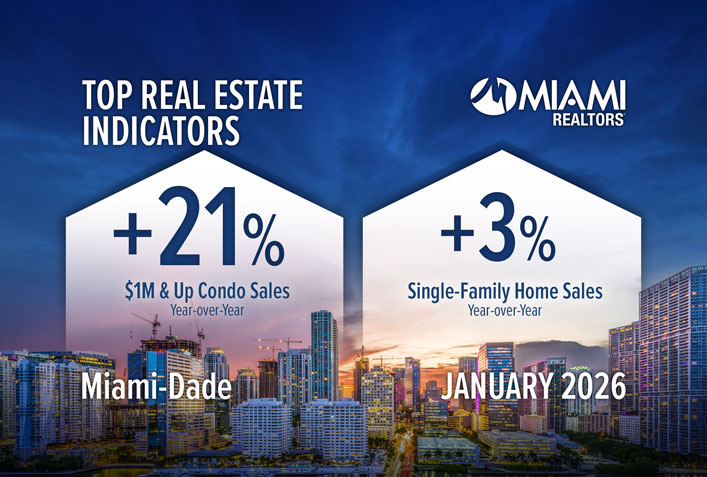
    MIAMI — Miami-Dade total home sales rose, single-family home transactions increased for the fifth-consecutive month and the resilient condo market maintained steady sales, according to January 2026 statistics released by the MIAMI Association of Realtors (MIAMI) and the MIAMI Southeast Florida Multiple Listing Service (SEFMLS).

    Total home sales (+1.2% y/y), single-family home transactions (+2.8% y/y) and total $1M & up home sales (+21% y/y) increased. Miami condo sales have maintained steady year-over-year sales for five straight months.

    “Miami is the where the world wants to be,” MIAMI Chairman of the Board Alfredo Pujol said. “Miami is the preferred home for billionaires. Miami’s Billionaire Bunker, an ultra-exclusive private island, is now home to Meta CEO Mark Zuckerberg, Amazon founder Jeff Bezos, financier Carl Icahn, NFL great Tom Brady and more; and that’s only one of our many incredible communities.”

    New South Florida real estate rankings:

    • #1 Ultra-Luxury Market in the U.S.: In 2025, South Florida posted the most $20M & up condo sales in its history; the second-most $10M & up total home sales in history; the second-most $10M & up single-family home sales; and the third-most $10M and up condo sales in history.
    • #1 Market in the U.S. for Cash Buyers: The Miami MSA leads the nation in all-cash sales, which means many buyers are operating on liquidity, not debt, so elevated mortgage rates don’t deter them.
    • #1 in the U.S. for Most Multifamily Construction: Southeast Florida has the most intense multifamily construction activity in the nation as of 2025 Q4, with 36,290 units, adding 9% to the current stock via MIAMI REALTORS® Research.
    • #1 in Home Equity: Miami-Dade home equity gains are nearly 2X the national figure. As of 2025 Q4, Miami-Dade County homebuyers who purchased a single-family home 15 years ago have a median equity of $560,790 compared to $300,504 nationally via MIAMI REALTORS® Research.

    Miami Total Sales Rise

    Total Miami-Dade sales increased 1.2% year-over-year in January 2026, from 1,764 to 1,869.

    Miami-Dade single-family $1M and up home sales increased 21.34% year-over-year in January 2026, from 164 to 199. Miami-Dade $1M and up condo sales climbed 21.36% year-over-year in January 2026, from 103 to 125.

    Affordable condos – priced between $500K to $600K increased 1.5% year over year, from 67 to 68.

    The sales total doesn’t include South Florida’s new construction, pre-construction and condo conversion sales because they are largely not reported in the MLS. But MIAMI led the charge to publish two new construction reports.

    International buyers purchased 49% of new South Florida construction, pre-construction and condo conversion sales over an 18-month period ending in July 2025, according to MIAMI REALTORS® first-ever New Construction Global Sales Report in collaboration with industry leaders.

    Our second New Construction Global Sales Report, published in November 2025, showed an increase in global sales and buyers from 73 countries, according to the MIAMI REALTORS® November 2025 Global Sales Report in collaboration with industry leaders.

    Miami-Dade Single-Family Home and Condo Sales Increase

    Miami single-family home sales increased for the fifth consecutive month. Miami single-family home sales increased 2.8% year-over-year in January 2026, from 643 to 661.

    Miami existing condo sales declined a negligible 0.1% year-over-year in January 2026, from 733 to 732. Miami condo sales had risen year-over-year in three of the last four months.

    The lack of Federal Housing Administration loans for many existing Miami condominium buildings is preventing further market strengthening. Of the 2,397 condominium buildings in Miami-Dade, Broward and Palm Beach counties, only 21 are approved for FHA loans, according to statistics from the U.S. Department of Housing and Urban Development.

    Just 0.9% of South Florida condo buildings are approved for FHA loans. Florida is the only state in the U.S. that requires a client to put down 25% for a limited review if the condo building doesn’t have enough in reserves. The requirement for every other state is 10%.

    Miami-Dade Condominium Sale Prices Have Appreciated 105% in the Last 10 Years

    Miami condo prices have risen 105% from January 2016 to January 2026, from $205,000 to $420,000. Miami condo prices increased again in January 2026 year over year, from $415,000 to $420,000.

    Miami condo median prices have stayed even or increased in 163 of the last 176 months, a span that covers 14.6 years.

    Miami-Dade County single-family home median sale prices increased 3.7% year-over-year in January 2026, from $675,000 to $699,990. Miami single-family median prices have risen in 168 of the last 170 months (14+ years).

    Miami single-family prices have risen 159.3% from January 2016 to January 2026, from $270,000 to $699,990.

    Miami’s surging multifamily market and the Florida Live Local Act should boost affordability in the future. Southeast Florida ranks No. 1 in the U.S. for most multifamily construction, according to MIAMI REALTORS® Research. This is important because it adds more overall housing/apartment supply to a city, creates more affordability and adds to Miami’s economic growth.

    Florida’s Live Local Act, which was passed in 2023 and amended in May 2024, is encouraging developers to build more affordable housing. The Live Local Act gives developers the highest density allowed in a local area if they allocate 40% of its units for affordable housing. The state law defines an affordable unit as being at or below 120% of an area’s median income.

    Miami remains a bargain in comparison to other global cities. For $1M, homebuyers can purchase 58 square meters of prime property in Miami, according to the 2025 Knight Frank Wealth Report. That is almost four times more than Monaco (19 square meters), nearly two times more than New York (34) and London (34) and more than Paris, Sydney, Tokyo and more.

    Mortgage Rates Declining

    Mortgage rates, which were above 7% at the start of 2025, have trended down in recent months. According to Freddie Mac, the 30-year fixed-rate mortgage was 6.10% in January 2026.

    “Bolstered by falling mortgage rates in late 2025 and vigorous demand from high-end buyers, Southeast Florida’s housing market started off strongly in 2026,” MIAMI REALTORS® Chief Economist Gay Cororaton said. “Momentum is likely to strengthen in the months ahead as mortgage rates fall further and as wealth migration from New York and California accelerate due to potential tax policy changes.”

    Total Miami Inventory is 25% Below Pre-Pandemic; New Listings Drop

    New listings are trending down and active listings are not growing as fast as they were at the start of the year.

    Total Miami-Dade inventory (17,942) is 25% below January 2019 pre-pandemic inventory (23,833).

    Total active listings at the end of January 2026 increased 5.6% year-over-year, from 16,992 to 17,942. Homebuyers are in a great position to find the right home and negotiate for a better price.

    Inventory of single-family homes increased 9% year-over-year in January 2026 from 4,983 active listings last year to 5,433 last month.

    Condominium inventory increased 4.16% year-over-year in January 2026, from 12,009 to 12,509 listings during the same period in 2025, but the total is still significantly below pre-pandemic. Current Miami condo inventory (12,509) is 24.2% below January 2019 pre-pandemic inventory (16,518).

    Months’ supply of inventory for single-family homes is 6.4 months, which indicates a balanced market. Inventory for existing condominiums is 13.7 months, which indicates a buyer’s market. A balanced market between buyers and sellers offers between six- and nine-months supply.

    Nationally, total housing inventory is 1.22 million units, according to NAR. That is up 3.4% from January 2025 (1.18 million). There is 3.7-month supply of unsold inventory, up from 3.5 months from one year ago.

    Miami Real Estate: $179 Million in Local Economic Impact
    Every time a home is sold it impacts the economy: income generated from real estate industries (commissions, fees and moving expenses), expenditures related to home purchase (furniture and remodeling expenses), multiplier of housing related expenditures (income earned as a result of a home sale is re-circulated into the economy) and new construction (additional home sales induce added home production).

    The total economic impact of a typical Florida home sale is $129,000, according to NAR. Miami-Dade sold 1,393 homes in January 2026 for a local economic impact of $179 million.

    Miami-Dade total dollar volume increased 13% year-over-year in January 2026 to $1.6 billion.

    Single-family home dollar volume increased 15.6% year-over-year to $936 million. Condo dollar volume increased 10.34% year-over-year to $638 million.

    Miami Distressed Sales Remain at Historic Lows, Reflecting Healthy Market
    Only 2% of all closed residential sales in Miami were distressed last month, including REO (bank-owned properties) and short sales. In 2009, distressed sales comprised 70% of Miami sales.

    Short sales and REOs accounted for 0.6% and 1.4%, respectively, of total Miami sales in January 2026.

    National and State Statistics

    In Florida, closed sales of single-family homes statewide totaled 16,298 in January 2026, up 5.9% year-over-year, while existing condo-townhouse sales totaled 6,084, up 5.1%.

    The statewide median sales price for single-family existing homes was $405,000, down 1.2% year-over-year, according to data from Florida Realtors Research Department in partnership with local Realtor boards/associations. Last month’s statewide median price for condo-townhouse units was $305,000, down 2.4% vs. last year. The median is the midpoint; half the homes sold for more, half for less.

    Nationally, total existing home sales decreased 8.4% year-over-year to a seasonally adjusted annual rate of 3.91 million, according to NAR. Median existing home prices increased to $396,800, up 0.9% from one year ago ($393,400) – the 31st consecutive month of year-over-year price increases.

    Miami Real Estate Attracting Near List Price
    The median percent of original list price received for single-family homes was 94% in January 2026. The median percent of original list price received for existing condominiums was 93%.

    The median number of days between listing and contract dates for Miami single-family home sales was 53 days, up from 45 days last year. The median time to sale for single-family homes was 96 days, up from 88 days last year.

    The median number of days between the listing date and contract date for condos was 71 days, up from 64 days. The median number of days to sale for condos was 117 days, up from 108 days.

    Miami Cash Sales More than National Figure
    Cash sales represented 44% of Miami closed sales in January 2026, compared to 42.2% in January 2025. About 27% of U.S. home sales are made in cash, according to the latest NAR statistics.

    Cash buyers are not deterred by rising rates. The high percentage of cash buyers reflects Miami’s top position as the preeminent American real estate market for foreign buyers, who tend to purchase with all cash as well as some moving from more expensive U.S. markets who can buy more with their profits from real estate sales.

    Cash sales accounted for 54.2% of all Miami existing condo sales and 32.7% of single-family transactions.

    To access January 2026 Miami-Dade Statistical Reports, visit http://www.SFMarketIntel.com

    Note: Statistics in this news release may vary depending on reporting dates. MIAMI reports exact statistics directly from its MLS system.

    Read more

    Billionaires keep buying homes in Miami. What does that do to the housing market?

    By Tom Hudson

    February 11, 2026 at 1:28 PM EST

    The founder of Facebook is the latest tech billionaire to buy a home in Florida. Meta CEO Mark Zuckerberg and his wife bought a home in the gated island community of Indian Creek, according to the Wall Street Journal.

    Amazon’s Jeff Bezos is among those who have homes there. Both of Google’s two founders also appear to have recently made moves for homes in Miami — Larry Page has purchased property in Coconut Grove, while Sergey Brin reportedly has a purchase contract for a home on Allison Island in Miami Beach.

    What do these multi-million dollar purchases by these billionaires tell us about the local housing market?

    To put it simply: taxes and temperature. Florida continues to be a beneficiary of low taxes relative to other states like California where many of these tech executives are moving from — and pretty good weather.

    These tech founders operate on a different level than most of us. It is not unusual for them to own several homes, oftentimes spending tens of millions of dollars for waterfront mansions here. With their riches, they probably aren't as sensitive to their property taxes or property insurance bills like the rest of us.

    These deals make headlines because of the big prices and the big personalities of the buyers. They are just the latest evidence that the so-called wealth migration to South Florida is still happening. And it’s not just tech billionaires.

    The Miami Association of Realtors found over 55,000 workers from out-of-state moved to South Florida in 2024. They were predominantly leaving California, New York and Texas.

    And they came with bigger paychecks.
    Floridians moving within Florida earned about $62,000 a year. The out-of-state workers moving to Florida earned a median paycheck of $101,000.

    To put it another way — for every dollar earned by someone moving to Florida from out of state, a Floridian moving earned about 62 cents.

    These higher paychecks added over $5 billion dollars in earnings to the region, according to the realtors group.

    What has been the impact on the housing market?

    Demand for single family homes has remained strong, especially for higher priced homes.

    More than half of the money spent buying homes last year was spent on single family homes of at least $1 million dollars. That is a record high share of the market.

    To some degree, that can be the result of the rising prices of single family homes across the region. After all, the median price of a home sold in December was over $600,000. Five years ago, it was closer to $400,000 dollars.

    READ MORE: Florida relied on immigration for almost all of its population growth last year

    Florida's population growth slowed considerably last year with fewer people moving here from someplace else in the U.S. and fewer people moving here from overseas. But — and this is key — the population kept growing. The impact of the slower growth on the housing market remains to be seen.

    More granular population data is due from the Census Bureau in March which will include how populations of individual counties may have changed. Last year there were at least two forces at play with Florida's population trends: the increasingly affordability challenge, especially of housing, and the Trump administration’s immigration enforcement, including efforts to cancel Temporary Protected Status of tens of thousands of immigrants living in Florida.
    But even if South Florida's population growth slows or stops, South Florida home building has not kept pace with past population growth.

    In 2024, the region’s population was up by about 275,000 people. Only a little more than 16,000 building permits for privately owned housing units were issued.

    President Trump recently signed an executive order banning large investors from buying single family homes. He said it was an effort to help affordability. However, the prevalence of corporate-owned homes is highly dependent on location.

    The Government Accounting Office found institutional investors owned about 5% of single family homes for rent in Miami. They study was conducted in 2022. Those big investors made up a larger portion of the rental home market in Orlando, Tampa and Jacksonville.

    Underpinning housing demand is the job market. The regional job market remains strong even as new job growth has slowed. The South Florida unemployment rate in December was 3.5% — one of the lowest among the largest metropolitan areas in the country.

    Read more

    Miami is #1 U.S. Market for Foreign Home Buyers; New MIAMI REALTORS® International Report Released Today

    by Chris Umpierre

    Share0

    2025 International Homebuyer Transactions of MIAMI REALTORS Members - January 2026

    2025 International Homebuyer Transactions of MIAMI REALTORS Members - January 2026

    MIAMI — Miami is once again the #1 U.S. destination for global home buyers as its foreign buyer share, global buyer dollar volume and total international sales increased year-over-year, according to the new 2025 Profile of International Home Buyers of the MIAMI Association of Realtors (MIAMI) released today.

    One in five of all U.S. international home sales happen in Florida and one in two in Florida are in the Miami metro market. South Florida foreign buyer share — foreign buyer residential purchases as a percentage of dollar volume — was 15% in 2025. That is seven times larger than the U.S. figure (2%) and more than three times larger than Florida (5%). Access the MIAMI report here: https://bit.ly/MiamiGlobal25

    “Miami is where the world wants to be,” MIAMI Chairman of the Board Alfredo Pujol said. “We are America’s youngest major city, filled with energy and innovation. We are the most welcoming and diverse community with unparalleled price appreciation. So, it’s no wonder why a staggering 93% of Miami global buyers purchased for security, profitability and location.”

    The profile surveyed MIAMI members’ international residential transactions for the one-year period from August 2025 to October 2025.

    Miami Global Buyer Dollar Volume, Global Buyer Purchases Surge

    Foreign homebuyers purchased $4.4 billion of South Florida residential properties in 2025, up from $3.1 billion in 2024. The total is larger than any other U.S. market. Global buyers bought 5,300 South Florida properties in 2025, up from 4,000 last year.

    The U.S. dollar’s slide against several major currencies and continued political instability, particularly in Latin America, spurred more foreign buying activity in Miami.

    A weaker U.S. dollar means more savings for high-net-worth overseas buyers looking to invest in Miami. The Euro was one of the strongest winners against the U.S. dollar last year.

    Political instability, especially in Latin America, leads to more global buyers looking for safe places to invest their money. Miami is at the top of the list not only because the city is the most diverse in the U.S. but because it boasts one of the nation’s top new construction condominium markets, a product global buyers love.

    International buyers purchased 49% of new South Florida construction, pre-construction and condo conversion sales over an 18-month period ending in July 2025, according to MIAMI REALTORS® first-ever New Construction Global Sales Report in collaboration with industry leaders.

    Our second New Construction Global Sales Report, published in November 2025, showed an increase in global sales and buyers from 73 countries, according to the MIAMI REALTORS® November 2025 Global Sales Report in collaboration with industry leaders.

    South Florida Secures 10% of all International Home Sales in the entire U.S.
    Florida is the top U.S. destination for foreign buyers (21% of all sales), according to NAR’s 2025 Profile of International transactions in U.S. Residential Real Estate. Florida has been the No. 1 state for foreign home buyers for the last 17years.

    About half of all international home sales (45%) in Florida are in Miami-Fort Lauderdale-West Palm Beach, according to the 2025 Florida Realtors’ annual Profile of International Residential Real Estate Activity in Florida.

    One in five of all U.S. international home sales happen in Florida and one in two in Florida are in the Miami metro market.

    South Florida secures 10% of all international home sales in the entire U.S. annually.

    About 93% of Miami global buyers purchased for security, profitability and location. 35% purchased because it was a secure investment; 25% for profitable investment and 33% for desirable location.

    While its foreign transactions remain strong, Miami continues to also benefit from a historic surge in domestic buyers – particularly from high-taxed, high-density locations such New York, California and New Jersey.

    Colombia: Top Foreign Country Buying South Florida Real Estate
    Colombia finished as the top foreign country purchasing South Florida real estate in 2025.

    The top countries of origin for consumers purchasing properties in South Florida are:

  • Colombia (15% of foreign buyer share)
  • Argentina (12%)
  • Mexico (7%) and Brazil (7%)
  • Venezuela (5%) and Canada (5%)
  • Peru (5%), Spain (4%) and Chile (4%)
  • Italy (3%)
  • The top two countries — Colombia and Argentina — account for 27% of all South Florida international closed sales.

    South Florida’s foreign buyers come from 55 countries. Other U.S. markets are often limited to two or three countries. The diversified number of markets that purchase in Miami allows the region to always post high global sales because when one foreign market declines, others step up to take its place.

    Countries purchasing in South Florida include: Argentina, Colombia, Canada, Brazil, Mexico, Venezuela, Peru, Chile, Ecuador, Spain, Israel, France, Italy, El Salvador, Costa Rica, Bahamas, Dominican Republic, Boliva, Paraguay, Sweden, Germany, Denmark, United Kingdom, Switzerland, Portugal, Greece, Turkey, Lebanon, Egypt, Saudi Arabia, Dubai, Iran, India, China, Vietnam, Malaysia, Indonesia, Malaysia, Ukraine, Poland, Russia, Japan, South Korea, Honduras, Australia, Austria, Turkey, Guatemala, Nicaragua, Haiti, Jamaica, Puerto Rico, Thailand, Slovenia and more.

    Miami-Dade County Has the Largest Share of South Florida Foreign Buyers
    Miami-Dade County accounted for the largest share of South Florida’s foreign buyers (73%). South Florida foreign buyer sales volume totaled $3.2 billion in Miami-Dade in 2025.

    Broward accounted for $785 million; Palm Beach had $123 million.

    Colombia is the No. 1 Country Buying in Miami-Dade County
    The top countries of origin for consumers purchasing properties in Miami-Dade are:

  • Colombia (18%)
  • Argentina (13%)
  • Brazil (9%)
  • Mexico (6%) and Venezuela (6%)
  • Italy (4%)
  • Peru (3%), Canada (3%), Spain (3%) and Honduras (3%)
  • Other countries that purchased properties in Miami-Dade include Chile, Cuba, Ecuador, Turkey, Dominican Republic, France, Haiti, Nicaragua, Australia, Costa Rica, El Salvador, Puerto Rico, Great Britain, Bahamas, Bolivia, China, Germany, India, Poland, Singapore, Ukraine, United Arab Emirates and United Kingdom.

    Colombia is the No. 1 Country Buying in Broward County
    The top countries of origin for consumers buying real estate in Broward County are:

  • Colombia (22%)
  • Argentina (15%)
  • Canada (10%
  • Brazil (7%)
  • Turkey (4%), Venezuela (4%), Peru (4%) and Dominican Republic (4%)
  • Israel (3%)
  • United Kingdom (2%)
  • Other countries that purchased properties in Broward include Chile , Haiti, Spain, Bahamas, Guatemala, Puerto Rico, Bolivia, Chile, Costa Rica, Cuba, Ecuador, India, Jamaica, Mexico, Russia, Ukraine, Great Britain and Uruguay.

    Argentina is the Top Country Buying in Palm Beach County
    The top countries of origin for consumers buying real estate in Palm Beach County are:

  • Argentina (34%)
  • Brazil (13%)
  • Jamaica (11%), Canada (11%), Colombia (11%), Dominican Republic (11%), Finland (11%)
  • MIAMI Foreign Home Buyers Spend 13% More on Average vs. Nationally
    Foreign home buyers spend more on real estate than other buyers, and South Florida real estate buyers spend a higher median price than other international buyers in the U.S.

    MIAMI international home buyers spent a median price of $558,700 for residential properties in 2025. In comparison, foreign buyers in the United States spend $494,400.

    Mexican buyers had the highest median purchase price of South Florida foreign buyers:

  • Mexico ($934,000)
  • Brazil ($777,400)
  • Colombia ($583,000)
  • Canada ($500,000)
  • Argentina ($458,100)
  • Venezuela ($450,000)
  • New York: Once Again Top State Purchasing in South Florida
    New York ranked as the No. 1 state purchasing in South Florida for the 6th consecutive year, according to the 2025 MIAMI Report. New York accounted for 24% of out-of-state buyers in 2025.

    Top out-of-state buyers:

  • New York (24%)
  • California (14%)
  • New Jersey (9%)
  • Georgia (5%) and Texas (5%)
  • Illinois (4%)
  • Massachusetts (3%), North Carolina (3%), Connecticut (3%)
  • Michigan (2%)
  • New York, California and New Jersey accounted for 47% of all out-of-state buyers in the Miami area in 2025.

    A surge of individuals and companies from high-density, high-taxed locations have relocated to Miami since the pandemic. Citadel, a multinational hedge fund company that manages $67 billion in assets, relocated from Chicago and is building a $1 billion Miami office tower.

    51% of South Florida International Buyers Paid in Cash
    According to the new MIAMI study, about 51% of all international residential transactions in South Florida were made in all-cash. The national figure is 47%.

    South Florida international home buyers prefer condominiums (51%, significantly higher than the U.S. average of 15%. South Florida global buyers prefer to purchase in the central/urban areas (63%), which they intend to use mainly as vacation or rental use (71%).

    65% of MIAMI Foreign Buyers Visited Florida Only 2 Times or Less Before Purchasing
    About 11% of South Florida foreign buyers purchased local homes without even visiting Florida in 2025. About 25% purchased with just one visit to Florida; 29% purchased with two visits; 16% bought after visiting Florida three times. About 65% purchased with two visits or less.

    About 43% of MIAMI members worked with an international client in the past 12 months. That’s two times the national figure of 20%.

    Survey results reflect MIAMI’s commitment to increasing South Florida’s real estate brand worldwide and the Miami real estate market’s position as a top international destination.
    MIAMI has 299 partner organizations worldwide and conducts international outreach on a global level.

    Read more

    Page 1 Of 10

    96 Articles Found

    >